

Fresh off a flight from Vietnam, the last thing I expected was to feel like I’d accidentally wandered into a James Bond film. Yet there it was, waiting for me in the arrivals bay at Mumbai airport: a Range Rover Sport SV, sitting low and wide and looking menacing under the harsh fluorescent lights.
For a brief, slightly delirious moment (blame the flight), I genuinely felt like M had arranged this. Except I had orchestrated it myself, which somehow made it better. This wasn’t just any Range Rover Sport: this was the SV. Special Vehicles. The version where Land Rover’s engineers apparently decided that ‘sensible’ and ‘restrained’ were dirty words and proceeded to build the most extreme, most focussed iteration of an already formidable machine.
The plan was simple: land in Mumbai, drive straight to Pune. It’s a familiar route that’s lost much of its ‘expressway’ charm over the years thanks to traffic, bottlenecks, and the infamous Lonavala crawl, where everyone collectively forgets how roads work. Google Maps was already informing me I’d be spending an extra hour and fifteen minutes in automotive purgatory. Normally, this would be soul-crushing, but not today, because sitting under my right foot was a 4.4-litre twin-turbocharged V8.
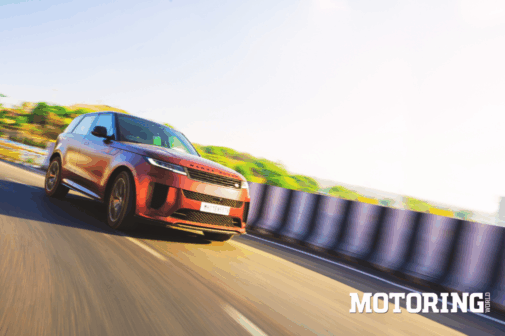
Rolling out of Mumbai’s chaos and onto the Atal Setu – that 21 km engineering marvel cutting across the sea – felt like entering a different dimension. The road opened up, the sea breeze filtered in, and for the first time since landing, there was actual space to breathe. So naturally, I did what any reasonable person would do: windows down, exhaust valves open, throttle pinned.
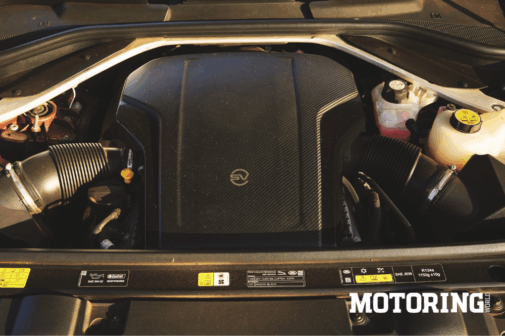
That V8 responds not just with speed, but with intent. There’s a deep, guttural rumble that builds into a full-bodied roar as the revs climb, the kind of noise that makes you grin like an idiot and simultaneously worry about noise pollution regulations. A couple of hard acceleration runs later (for research purposes, obviously), and it becomes immediately clear that calling this thing ‘quick’ is like calling the ocean damp. The damn thing is ferocious. It feels less like an SUV and more like a low-flying cruise missile that happens to have leather seats and climate control. Point it in a direction, squeeze the throttle, and it simply fires forward with devastating force, accompanied by a soundtrack that could make grown adults weep with joy.
At the heart of the Range Rover Sport SV lies a BMW-sourced 4.4-litre twin-turbo V8. Unlike the new electrified M5 (which is brilliant, but also weighs as much as a small building), this one keeps things refreshingly old-school. There’s no hybrid assistance, no battery pack to soften the edges, no ‘but think of the planet’ guilt trip. There’s only raw combustion doing what it does best: converting dinosaur juice into speed and noise.
The numbers? 635 bhp and 86.67 kgm of torque. These figures are staggering when you consider they’re moving a machine that weighs close to 2.5 tonnes, roughly the same as a fully-loaded Land Rover Defender or a small herd of elephants.
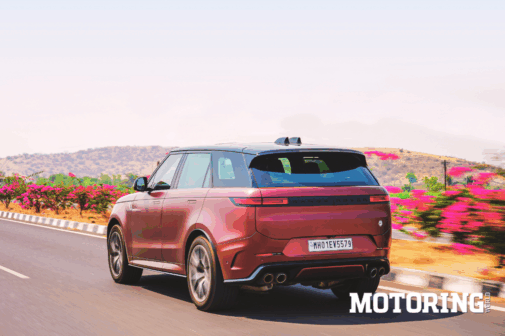
The 0-100 kph sprint comes up in just 3.8 seconds, which is firmly in supercar territory and absolutely absurd for something this large. But here’s what’s even more impressive: the way it builds speed beyond that initial launch. The surge from 100 to 200 kph is relentless and almost disorienting, shrinking distances in a way that feels completely at odds with the laws of physics and common sense. The 8-speed automatic gearbox delivers sharp, decisive shifts that feel almost telepathic, while the paddle shifters add a layer of engagement when you want to pretend you’re Sebastian Vettel, with the emphasis being on ‘pretend’.
Performance is only one side of the story. Making something this large and heavy handle with precision? That’s where the real engineering brilliance comes in, and where Land Rover’s SV division earns its keep. The highlight here is the 6D Dynamics suspension system, a hydraulically interconnected setup that replaces traditional anti-roll bars. If that sounds like engineering jargon, here’s what it actually means: through long, fast corners and sweeping highway bends, the Sport SV remains remarkably flat and composed. You sit high, yet the car feels planted and confidence-inspiring in a way that encourages you to push harder than you probably should. We’ve experienced this 6D suspension in the Defender Octa, and it performs exactly as advertised, which is to say, like some sort of hydraulic sorcery.
Of course, you can’t completely cheat physics. Under heavy braking, the weight does make itself known – 2.5 tonnes doesn’t stop quite as quickly as a Porsche Cayman, shocking as that may be. But in most real-world conditions, the stability and composure more than compensate.
Then there’s the rear-wheel steering, which adds yet another layer to this technological onion. In tight, congested traffic (especially through the chaos of Lonavala, where every driver seems to be operating under their own unique interpretation of traffic laws) it transforms the car’s character. The rear wheels subtly turn, effectively reducing the turning circle and making the SUV feel far smaller than it actually is. What should feel cumbersome instead feels surprisingly agile. You can thread through traffic with confidence, slot into parking spaces that look too small, and generally behave like you’re driving something half the size.
Despite spending nearly 45 minutes crawling through Lonavala traffic – during which I contemplated the meaning of existence and why humanity invented the internal combustion engine if we’re just going to sit still in it – the Mumbai-Pune run was completed in under three hours. More importantly, I stepped out of the car feeling fresh and relaxed, with none of the fatigue that usually follows a long drive after a flight.
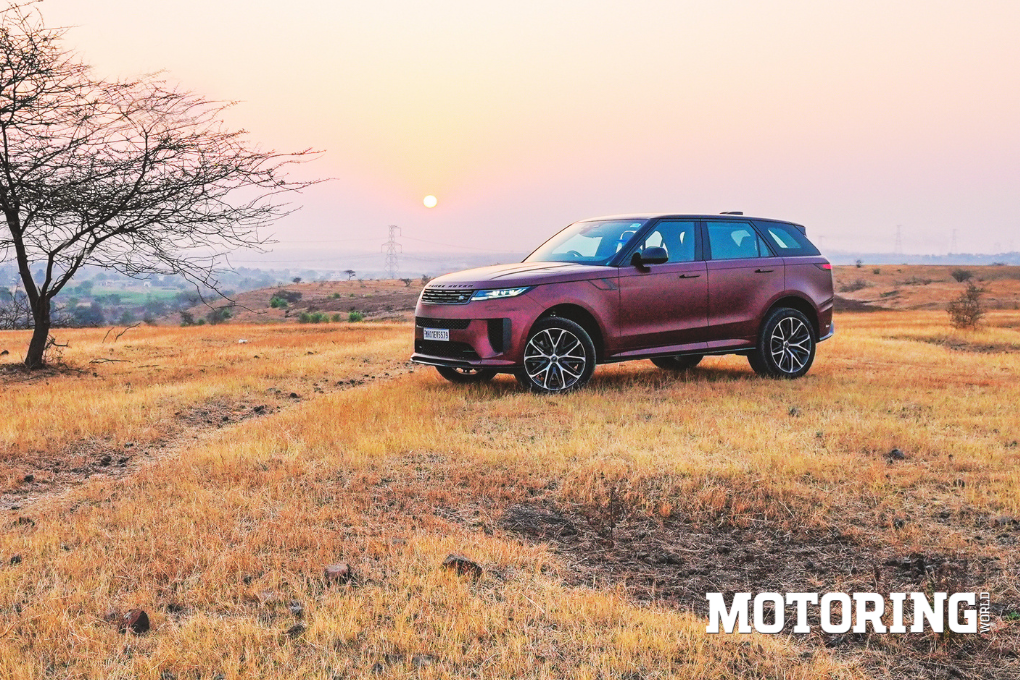
The next morning offered a chance to slow things down and actually appreciate what this thing looks like. At sunrise, the ‘Sunrise Copper’ matte finish revealed its true depth and character – it’s a colour that manages to stand out without being obnoxiously loud, drawing attention in a more understated way (insofar as a 2.5-tonne Range Rover can be understated).
Perched atop a small hill just outside Pune, the Sport SV looked every bit as dramatic as it had the night before, but in a completely different way. Tall, wide, and unmistakably Range Rover, it carries an inherent sense of presence that’s hard to articulate without sounding like a car brochure. The design remains clean and minimalist (by modern SUV standards, anyway), but the SV-specific touches add just the right amount of aggression. Forged carbon fibre elements, massive wheels, quad exhausts, and subtle badging all come together to create something that feels both elegant and purposeful, like a well-tailored suit that happens to be bulletproof.
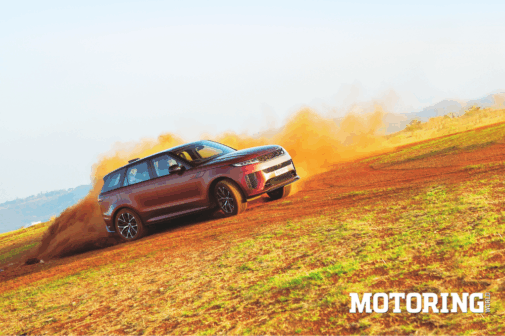
Later, on a loose gravel patch (because we’re automotive journalists and this is what we do with expensive cars that don’t belong to us), the Sport SV revealed yet another side to its personality. With traction control switched off – always a good decision – it becomes surprisingly playful. Feed in the throttle, and the rear begins to step out in a controlled, progressive manner. Hold it there, apply some opposite lock, and suddenly you’re drifting a 2.5-tonne luxury SUV like you’re Ken Block’s slightly less coordinated cousin. It feels absurd. It is absurd. But it’s also incredibly satisfying.
What stands out is how predictable and composed it remains even in these situations. There’s a sense of balance and control that gives you the confidence to explore its limits, something you wouldn’t normally associate with a vehicle of this size. Most SUVs this large feel like they’re constantly reminding you that they’re heavy and expensive and maybe you should calm down. The Sport SV actively encourages mischief.
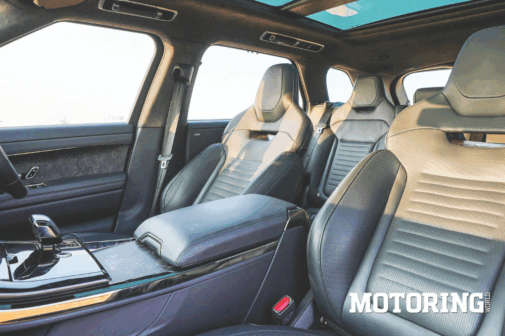
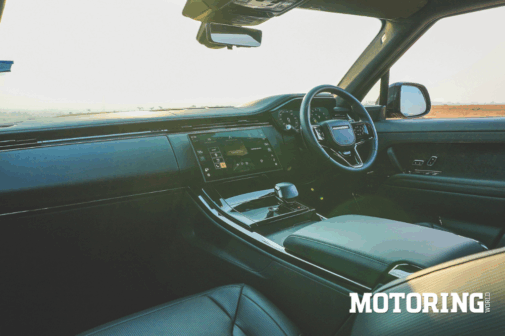
Inside, the focus shifts seamlessly from ‘let’s see how sideways this thing can get’ to ‘let’s appreciate fine craftsmanship.’ The cabin is a showcase of modern design, with a minimalist layout elevated by extensive use of forged carbon fibre. It adds a technical, almost artistic touch that feels reminiscent of high-end watchmaking (appropriate, given the price tag).
The front seats strike an impressive balance between support and comfort. They hold you in place during spirited driving, while remaining plush enough for long-distance cruising. The adjustability is extensive to the point of being slightly overwhelming; there are approximately 47 different ways to configure these seats (I may be exaggerating, but only slightly). In the rear, the experience remains just as impressive. There’s ample space, reclining functionality, and a sense of openness enhanced by the panoramic sunroof. It continues to deliver the kind of comfort and practicality that has always defined the Range Rover brand.
The 13.1-inch Pivi Pro infotainment system acts as the central hub for almost every function in the car. It’s slick, responsive, and visually clean, integrating everything from climate controls to drive modes into a single interface. However – and this is where my old-man-yells-at-cloud tendencies emerge – the reliance on the touchscreen does come with drawbacks. With very few physical buttons available, even simple adjustments require a few extra steps and far too much looking at screens instead of the road. While the system works well, there’s a growing case for bringing back more tactile controls, especially for frequently used functions. Sometimes you just want to twist a knob without navigating through three menus, you know?
Fuel efficiency? Let’s not pretend this matters to anyone considering a 635 bhp Range Rover, but for the record: it averages around 7 kpl. The Sport SV makes no attempt to hide its thirst, and honestly, it feels almost endearing in its honesty. This is a car that drinks fuel the way I drink coffee: enthusiastically and without regret. But here’s the thing: you’re getting performance that rivals dedicated sports cars, combined with the comfort, space, and versatility of a luxury SUV. It’s a trade-off that makes complete sense, especially for those who value the experience over outright efficiency. If you’re worried about fuel costs, you’re definitely shopping in the wrong category.
If there was ever an automotive equivalent to ‘float like a butterfly, sting like a bee,’ this is it. The Range Rover Sport SV performs in a way very few cars can. It’s brutally fast when you want it to be, yet calm and composed when you need it to be. It handles with surprising agility, delivers immense comfort, and carries an undeniable sense of presence wherever it goes.
Yes, it faces strong competition from German rivals: the Porsche Cayenne Turbo, the BMW X5 M, the Mercedes-AMG GLE 63, all of which are excellent in their own right. But where they often focus purely on performance metrics and beating each other in spec-sheet wars, the Range Rover offers character, and a sense of occasion that’s hard to quantify, but immediately apparent the moment you fire up that V8 and hear it rumble to life.
In the end, it’s not just about how fast you go (though 3.8 seconds to 100 kph is laughably quick). In this SUV, every journey feels special, whether you’re blasting down the Atal Setu at speeds best left unmentioned, crawling through Lonavala traffic, or hooning on gravel. It’s Muhammad Ali in a bespoke suit. And honestly? That might be the most compelling combination on four wheels.