

The front wheel hovered just long enough for me to notice it. Not a dramatic, social-media-friendly wheelie. Just a quick clutch-up as the revs climbed and the Tracker 400 surged forward. It wasn’t intentional, but it perfectly summed up the motorcycle underneath me. Because despite the flat-track styling, race-inspired number boards and broad handlebars, the Triumph Tracker 400 isn’t merely a styling exercise. It’s a motorcycle with genuine attitude. And perhaps more importantly, it finally fills the gap between the Speed 400 and the Thruxton 400.
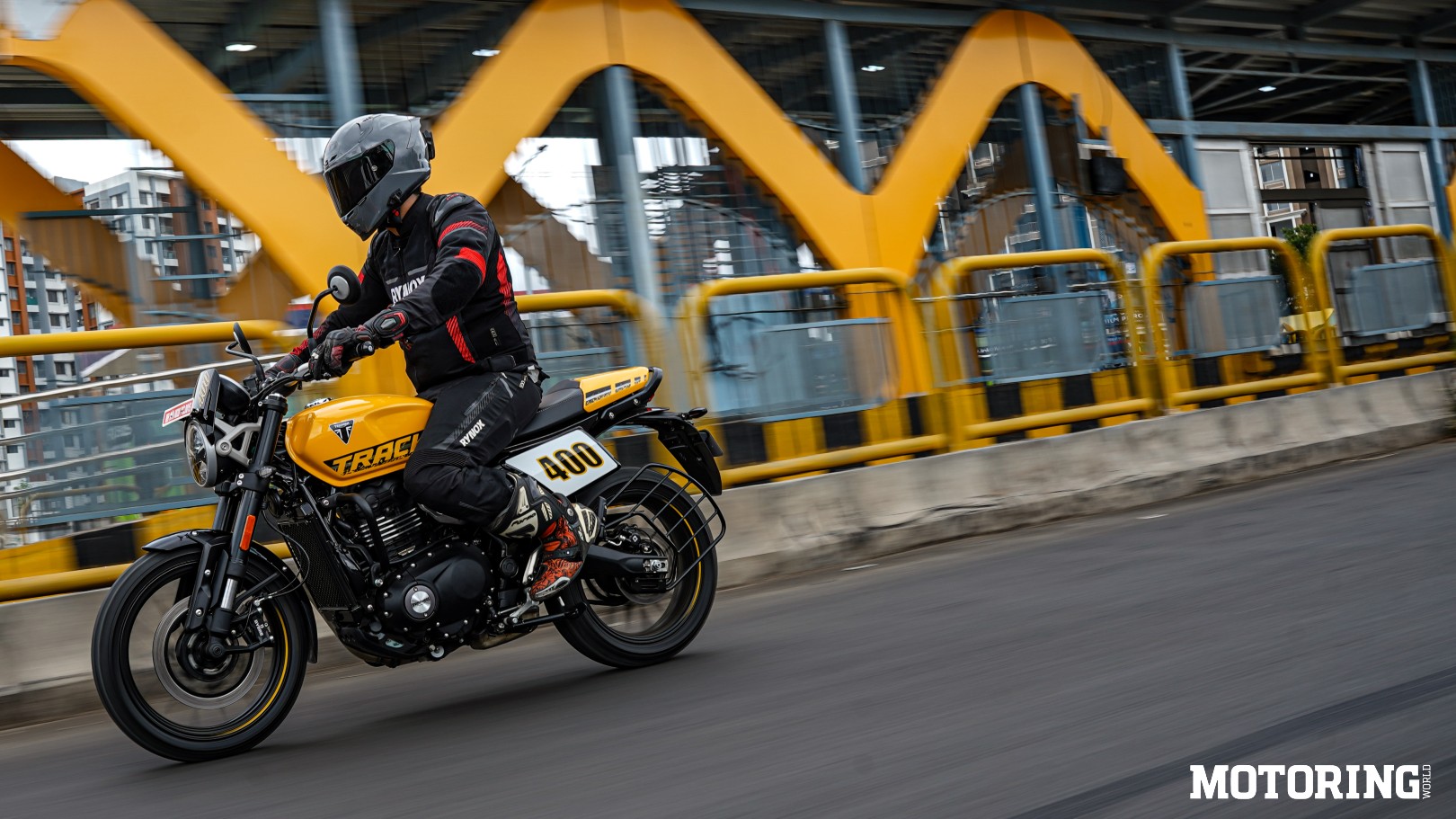
Flat-track racing has always been about controlled aggression. Riders slide motorcycles through dirt ovals with elbows out, rear wheels dancing beneath them and engines screaming for more revs. The Tracker 400 borrows heavily from that culture, at least visually. The race-plate-style side panels immediately stand out, as do the tracker-style fuel tank, flyscreen and twin upswept silencers. It looks lean, purposeful and noticeably more substantial than the Speed 400.
The yellow paint scheme is easily the pick of the lot. Combined with the tracker proportions and wide handlebars, it has a presence that attracts attention wherever it goes. People may not immediately know what it is, but they know it looks different. Thankfully, the riding experience backs up the styling.


Power comes from the familiar 349cc single-cylinder TR-series engine, but the tune is shared with the Thruxton 400. Producing 39.4 bhp and 3.26 kgm, it is among the most enthusiastic engines in the segment. The revised sprocketing — a combination of the Scrambler’s 43-tooth rear sprocket and the Speed’s 15-tooth front sprocket — helps sharpen its responses further.
Unlike the Speed 400, which majors on flexibility and easy-going performance, the Tracker’s character is more focused on the top end. There is still enough bottom-end grunt to trundle through traffic without fuss, but it clearly prefers being revved. Twist the throttle and the engine spins eagerly towards the redline, rewarding riders who enjoy chasing revs.
As a result, acceleration feels brisk. Sprinting to highway speeds happens quickly and overtakes are dispatched with ease. However, unlike torque-heavy motorcycles that simply bulldoze their way past traffic, the Tracker asks you to maintain momentum and work the engine. It’s more engaging as a result.

Helping matters is a slick gearbox that never feels clunky or reluctant. Gear shifts are precise, while the clutch action remains light enough for daily commuting duties. The exhaust note, meanwhile, retains the familiar Triumph character — throaty, loud and guaranteed to draw attention.
The biggest difference between the Tracker and its siblings, however, is the riding position.
Compared to the Speed 400, the hydroformed aluminium handlebar sits 134 mm lower. The footpegs have moved 86mm rearward and 27 mm higher. On paper, that sounds like a recipe for discomfort. In reality, Triumph has found an impressive middle ground.

The riding position feels sportier than the Speed but nowhere near as committed as the Thruxton. There’s no excessive weight on the wrists and no awkward stretch to the bars. Instead, you sit in a posture that feels engaged without becoming tiring. It’s the sort of setup that encourages spirited riding while remaining perfectly usable every day.
The 805-mm seat height also makes the motorcycle accessible to a wide range of riders. My only complaint concerns the fuel tank. While the sculpted shape looks great, the edges of the 13-litre tank constantly pressed against my inner thighs. It isn’t a deal-breaker, but it is something I noticed throughout the ride.
The Tracker’s handling is equally impressive. Its tight proportions and wide handlebars make city riding effortless. Filtering through traffic feels natural, and the motorcycle changes direction eagerly. Yet once the road begins to twist, the Tracker reveals another side of its personality.

Borrowing heavily from the Thruxton’s chassis setup, including its sharp 24.3-degree rake angle, the Tracker feels genuinely entertaining through corners. Turn-in is quick, mid-corner stability is reassuring and the motorcycle encourages you to carry speed through bends.
At 181kg (kerb), it never feels intimidating or cumbersome. In fact, it feels lighter than the number suggests. Newer riders will appreciate the approachable nature of the motorcycle, while experienced riders will enjoy how willing it is to attack a favourite stretch of road.
The suspension setup strikes a sensible compromise. It is firm enough to support spirited riding and maintain composure during aggressive cornering, yet compliant enough to absorb the punishment of everyday roads without drama.
Braking performance is equally confidence inspiring. Using the same sintered pads as the Speed 400, the setup offers strong stopping power along with excellent feel at the lever. The ABS calibration is also well judged, intervening only when necessary.
Not everything is perfect. The engine becomes noticeably vibey beyond 8,000 rpm and, despite the performance-focused tune, there isn’t a particularly muscular low or mid-range punch. Riders upgrading from smaller motorcycles may not mind, but those expecting effortless shove everywhere in the rev range could be left wanting more. A quickshifter would also have complemented the Tracker’s sporty personality nicely. Yet these shortcomings do little to dilute the Tracker’s appeal.
At ₹2.46 lakh (ex-showroom), the Triumph Tracker 400 feels like the missing link between the Speed and Thruxton. It delivers nearly all the performance and excitement of the latter while offering a more comfortable riding position and a stronger visual identity. More importantly, it succeeds in feeling like more than just another derivative of Triumph’s 400cc platform. It looks distinctive, rides beautifully and has an engine that constantly encourages you to chase the horizon. And occasionally, lift the front wheel while doing it.