

The Honda City has been on sale in India for almost three decades, which is one heck of a longevity streak. It has seen sedans fall steadily out of fashion across that time, overtaken in volume and attention by SUVs at nearly every price point. The City survived anyway, not through radical reinvention, but because a specific kind of buyer — one who values reliability and a composed driving experience over visual drama — continued to find it the most honest answer to their requirements. That consistency is harder to maintain than it looks, particularly when the segment around you is shrinking and the temptation to chase SUV-style drama grows stronger with each update cycle. Honda has resisted it, and this Honda City Hybrid is built around the same logic as every City before it.
The update is a refresh rather than a redesign, and Honda has been straightforward about that. The current-generation platform is approaching five years of age, and the changes are aimed at keeping it visually current and electronically relevant, rather than fundamentally altering what the car is.
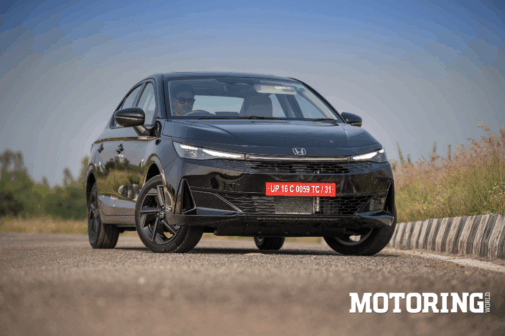
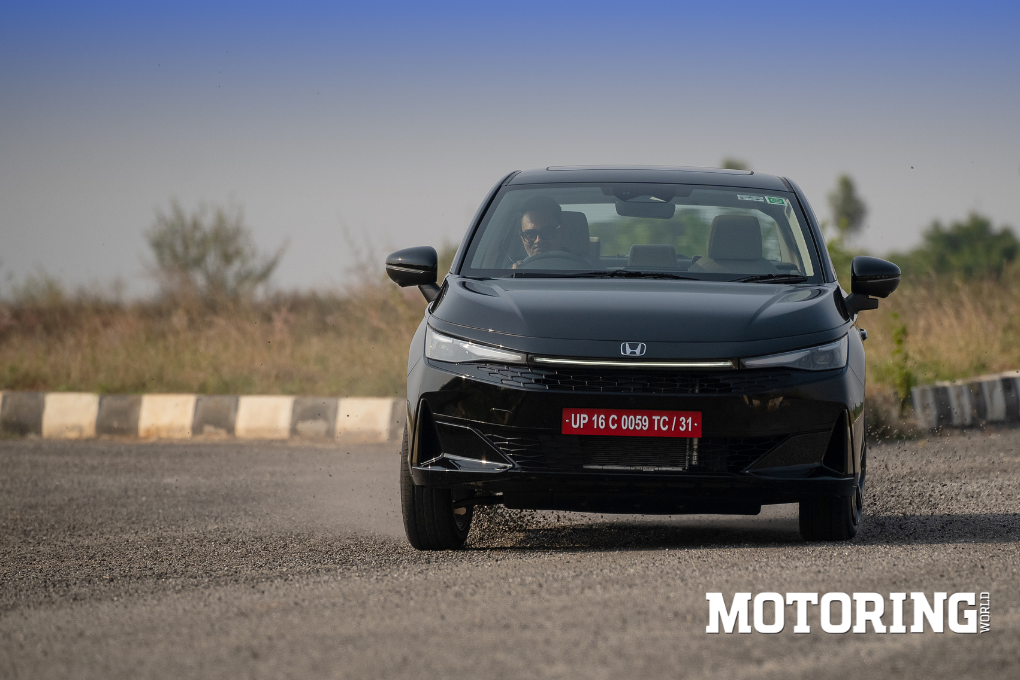
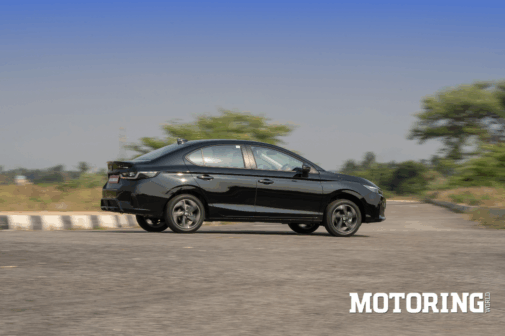
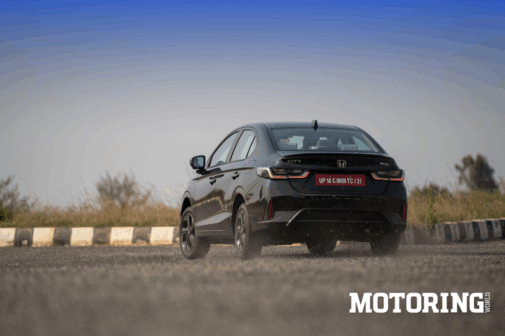
Up front, the face is sharper and cleaner than before (and there are hints of a certain Japanese luxury sedan from a segment above). Slimmer LED headlamps carry a two-part DRL signature, connected by a light bar across the front — the first time Honda has used this treatment on a sedan in India. The honeycomb grille replaces a chrome-heavy arrangement that had aged less gracefully than the rest of the car. The redesigned bumper carries a wider central air intake and revised lower detailing that gives the front end a more purposeful stance. The changes add visual maturity without unsettling the proportions that have always made the City a balanced-looking car. In profile it is unchanged, which is a reasonable decision — the long wheelbase, clean shoulder line, and glasshouse remain as well-judged as they were at launch. The rear gets revised bumper and taillight detailing that ties the updated front end together coherently. The Crystal Black Pearl shade on our car suited the design well; the car looked attractive rather than showy, which is exactly the impression it has always aimed for.
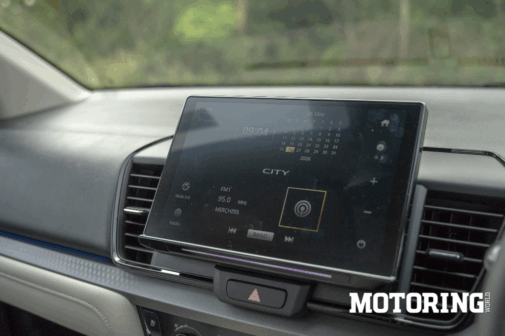
Inside, the most significant change is the 10.1-inch touchscreen, mounted at an angle on the dashboard, rather than flush with it. In all honesty, it’s not a design that works very well; it looks like an afterthought, and visibility isn’t great in bright sunlight. Honda has retained physical controls for climate — rotary dials and proper buttons — which is absolutely the correct decision for a car used primarily in urban traffic, where operating a touchscreen for fan speed is a distraction rather than a convenience. The new gesture controls on the touchscreen are worth discussing specifically: three fingers adjust volume, two fingers skip tracks. This sounds like a gimmick and in other implementations it often is, but across a full day of driving in Bengaluru, it proved useful. Reaching for small on-screen icons while navigating congested junctions takes attention away from the road; the gesture system reduces that without requiring any adjustment to driving habits.
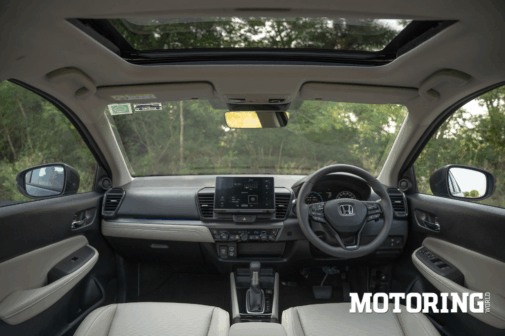
Ventilated front seats are a new addition, and their usefulness in India’s heat required no demonstration. A 360-degree camera has been added, which makes reversing into tight spaces — a daily requirement in most Indian cities — less stressful; the camera’s perspective isn’t the best, however. The existing feature set carries over: wireless Apple CarPlay and Android Auto, ambient lighting, wireless charging, an electric parking brake with auto hold, a sunroof, and an eight-speaker audio system that performs adequately for the segment. The Level 2 ADAS suite is retained — adaptive cruise control, lane keep assist, automatic emergency braking, and road departure mitigation. The lane-watch camera, which displays a live feed of the left blind spot when the indicator is activated, remains one of the more useful safety features at this price point; it requires no habit change from the driver and delivers immediately useful information. Six airbags are standard throughout the range.
The real talking point, however, is what’s under the bonnet. Honda has slowly shifted from the old VTEC joy-of-driving era toward intelligent efficiency. The City Hybrid perfectly reflects that transition. Back in the day, the VTEC badge alone carried an emotional connection. If you remember the ‘VTEC kicked in yo’ memes, you know exactly what era of Honda magic we are talking about. But times have changed, and today’s buyers want less stress at the fuel pump, and ownership that doesn’t demand compromises.
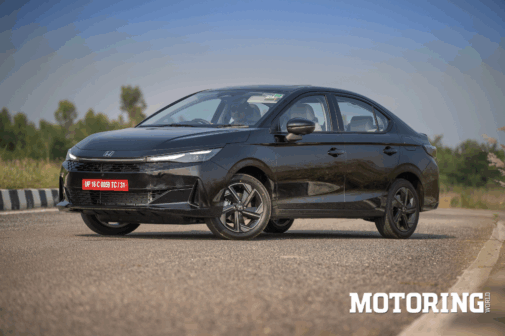
The powertrain is the City Hybrid’s clearest differentiator. Honda’s 1.5-litre strong-hybrid setup produces 126 bhp and 25.8 kgm of torque through an e-CVT, and the system has not been revised for this update, because it did not need to be. What it offers is something distinct from both conventional petrol cars and full EVs. There is no charging infrastructure to locate or plan around, no range anxiety on unfamiliar routes, and no adjustment required in how you use the car day to day; you just fill it with petrol as you always have. The electric assistance operates in the background, and the transitions between electric-only and combined drive are smooth enough to go unnoticed in normal use; this is the kind of engineering refinement that only becomes apparent when you drive a less sophisticated hybrid system and notice the jolt. Honda claims 27.26 kpl on the ARAI cycle. A full day of Bengaluru driving returned figures suggesting real-world efficiency genuinely close to that number, which is an unusual outcome for an ARAI claim. Honda now backs all hybrid components with a five-year warranty, which addresses one of the few reservations buyers previously raised about long-term ownership costs.
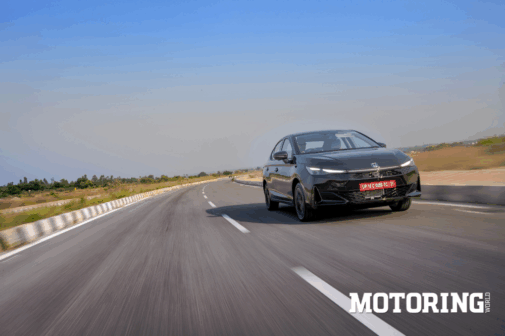
On the roads beyond the city, the driving experience is calm and deliberate. Throttle response is tuned for efficiency rather than urgency, and the car builds speed in an unhurried way that suits long drives better than it suits traffic light starts. The e-CVT is smooth and unobtrusive; it does not create the elastic, disconnected sensation that characterises less refined CVT systems. This is not a car that rewards being pushed, however, and it does not invite that behaviour; the whole powertrain is calibrated around a different brief.
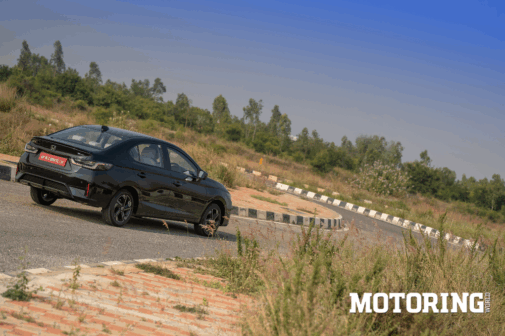
The steering is light and accurate in urban conditions, with enough weight at higher speeds to feel stable without demanding effort. The ride quality handles highway surfaces and gentle undulations well. Sharper potholes do register in the cabin, a characteristic of the sedan body and relatively modest ride height rather than a specific flaw in the suspension tuning. Ground clearance is the platform’s persistent limitation on urban roads; larger speed breakers and uneven junctions require care, and this is a consideration for buyers in cities where road surfaces are inconsistent. Honda should really consider increasing the ground clearance slightly. Visibility is one of the car’s consistent strengths — the large glasshouse, slim pillars, and well-positioned mirrors make it easy to place accurately in traffic, in multi-storey car parks, and in the narrow gaps that Bengaluru’s older neighbourhoods regularly present.
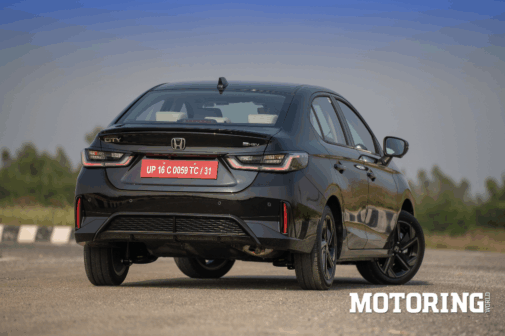
The Honda City has never been the most exciting car in its segment (or at least not since its 2nd generation). The Hybrid version makes no attempt to change that. What it offers is a powertrain that is very efficient in everyday use, a cabin that is well-equipped and thoughtfully laid out, and an ownership experience built around simplicity. Globally, Honda is scaling back parts of its EV ambitions, though India will still see electric offerings from the brand. After spending quality time with the City Hybrid, it feels like the more sensible real-world solution right now. For the buyer who has always found the City’s proposition convincing, this update strengthens it. If you’re considering a sedan at this price for the first time, the hybrid system removes most of the hesitation that surrounds alternative fuel options, without asking for any change in driving behaviour. That is a focussed brief, and Honda has executed it with the consistency this nameplate has always delivered.