

Two decades ago, the Bajaj Pulsar 150 UG3 made its debut, and it was unlike anything I had ever seen in the flesh. The menacing wolf-eye headlamps, angular tail section, semi-digital instrument console and backlit switchgear… in 2006! And in that all-black avatar, it looked like something straight out of a movie to the then-teenager me.
A lot has changed since then, hasn’t it? Not just me, but the way the market perceives the 150–160cc segment. What was once the performance benchmark has gradually become the premium commuter class. Which brings me to the question: does this 2026 Pulsar 150 still have that unmistakable ‘Pulsar charm’?
Well, going by the looks, it does. It has the same iconic silhouette, with the sporty headlight cowl, muscular fuel tank and angular tail section. Even though every panel has been redesigned, it still looks remarkably similar to the UG3 Pulsar. But watch each part closely and you’ll see a different story.

The headlight, for example, doesn’t look as menacing as it once did with these new ‘wolf eyes’. Then there’s the exhaust. I cannot imagine seeing any other shape than a beefy cylindrical unit on a Pulsar, but this one looks rather different. And something that was too personal for me was the lack of Bajaj logos on the bike. Except for the engine case, there’s none on the motorcycle, unlike the older model. One chrome logo between the wolf eyes would have been a nice touch. But all of those little disappointments just disappeared as soon as I thumbed the starter.
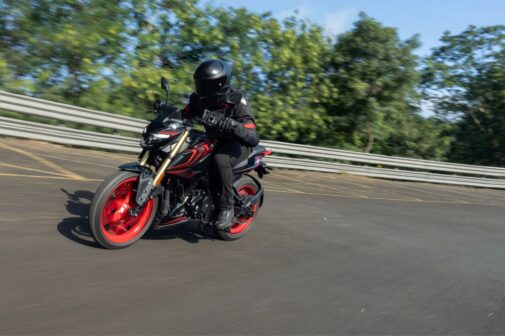
The new 149.5cc engine feels super refined at idle, but there’s still a little gruffness from the exhaust that gives it some character. And as I pulled away, I realised it wasn’t just at idle that the bike felt this refined.
Bajaj says 85 per cent of the 14.1 Nm of torque is available from as low as 3,000 rpm, and you can feel it. There’s a punchy bottom and mid-range without compromising much on the top-end. City riding is rather effortless, thanks to the engine’s tractability. With ample torque available from low down, you can make your way through traffic without constantly modulating the clutch or working the gearbox.

The 40–80 kph zone is where the Pulsar feels particularly engaging. There’s a strong pull that takes you from city speeds to highway-safe cruising speeds without much fuss. And even beyond 80 kph, the Pulsar can stay there all day long. Overtaking at those speeds doesn’t require much effort either.
It is the sort of performance that feels reassuring rather than exciting for the sake of it. The Pulsar doesn’t need to be thrashed to make progress, and that makes it particularly easy to live with.
Refinement is another area where this Pulsar has come a long way. There are almost no vibrations throughout the rev range. In fact, what started with the N160 and P150 in terms of refinement has finally made its way to the OG Pulsars. The throttle response is precise, too. In Sport mode, it feels at its most eager, while Rain mode makes the responses slightly lazier.
The light and precise clutch only adds to that effortless nature. The gearbox is slick and easy to operate, and because the engine is so tractable, I rarely found myself needing to work it hard in traffic. Then there’s the way it handles.
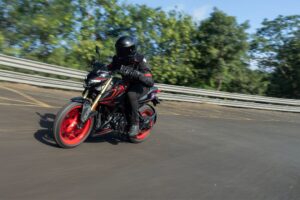
The new Pulsar 150 is 9 kg lighter than before, and that reduction is immediately evident. It feels easier and more effortless to flick through traffic, but unlike the Pulsar 125, it doesn’t feel overly eager. Instead, it has a mature, calm way of tipping into a corner.

That’s particularly interesting when you consider that it runs the same skinny 100-section rear tyre as the Pulsar 125. Yet there’s enough composure here to make the bike feel planted rather than nervous. The brakes have good stopping power and a healthy initial bite. However, the single-channel ABS is a tad too intrusive for my liking.
The reduction in weight also seems to have done wonders for the suspension. The Pulsar deals with bad roads pretty well, ironing out smaller potholes and undulations without much fuss. Sharper potholes, however, still make their presence felt.
Ergonomics, thankfully, are spot on. The wider tank makes it easy for bigger riders to grip the bike, while the 790-mm seat height makes it accessible to riders of different sizes. It strikes a good balance between feeling substantial without becoming intimidating.

There’s plenty of modernity here, too. The 5-inch TFT console with Bluetooth connectivity is easy to read and certainly looks the part. But it isn’t perfect. The interface can be laggy, and toggling through the riding modes is a bit of a task. It feels like one of those occasions where adding technology has not necessarily made the experience simpler.
And yet, none of that really matters when you take a step back and look at what the Pulsar 150 has become.
The reason why this motorcycle continues to sell, and continues to exist in this format despite the N160 and NS160, is the aspirational value it has built over two decades. Think about that for a moment. Bajaj has updated this motorcycle, and even after 20 years, it has deliberately retained enough of the original design for you to recognise it instantly. It looks like a Pulsar because it is supposed to look like a Pulsar.
That, ultimately, is the charm.
The 2026 Pulsar 150 is far more refined than the motorcycle I remember from my teenage years. It packs a whole bunch of modern features, is lighter, more fuel efficient and considerably easier to ride. But underneath all those changes, it still feels like a Pulsar at heart. And perhaps that is why it has survived while the definition of the 150cc motorcycle around it has changed so dramatically.

The teenager who first saw that all-black UG3 in 2006 may not find quite the same menace in the new wolf eyes. But ride the 2026 Pulsar 150, and you realise that perhaps the charm was never really in the eyes to begin with.