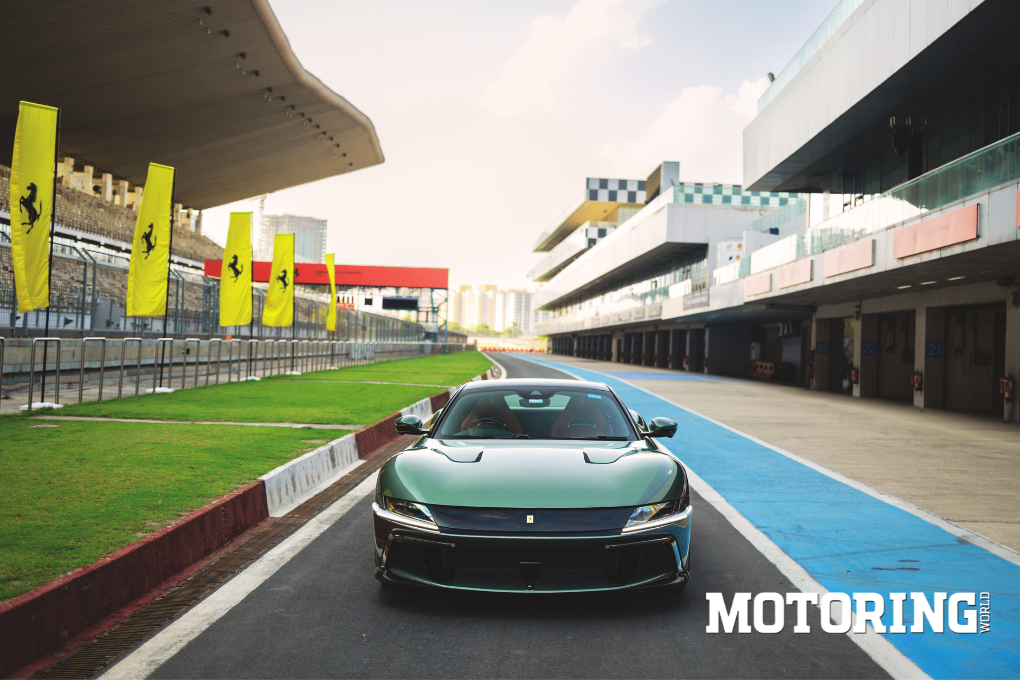


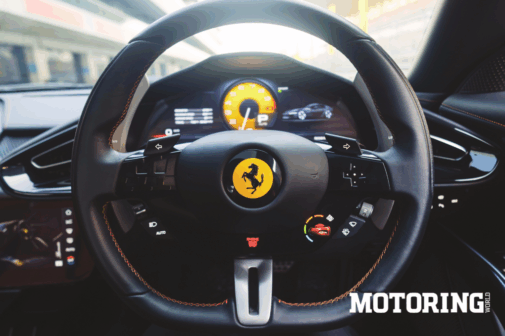
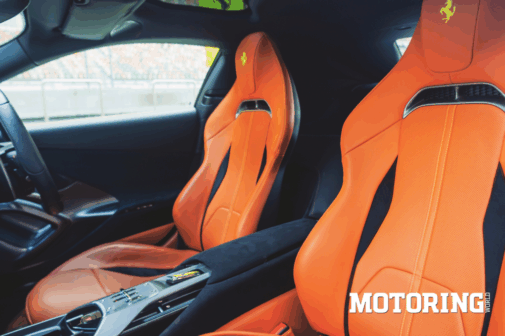
Helmet on. Seatbelt tight. The carbon fibre bucket seat holds you in a perfect, uncompromising embrace, comfortable enough for long drives, supportive enough that you won’t slide around when things get exciting (and things are about to get volcanic). The Manettino dial on the steering wheel clicks to ‘Race’. This is actually happening.
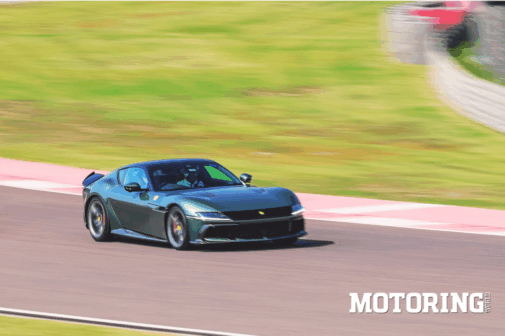
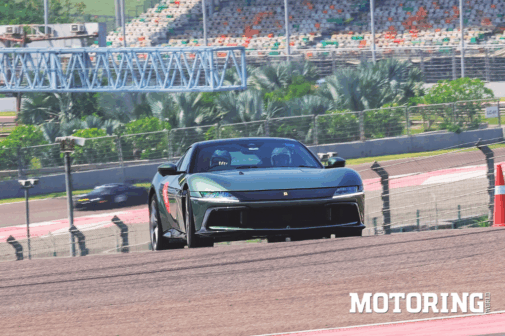
Rolling out of the pit lane at the Buddh International Circuit, the first sensation that strikes you is the 12Cilindri’s astonishing visibility. That long, seemingly endless bonnet stretches out before you like an aircraft carrier, yet the car feels surprisingly compact, almost shrinking around your body as you begin to familiarise yourself with its responses. It’s the opposite of driving a modern SUV, where you’re essentially piloting a building from the third floor.
Approaching Turn 1 — a heavy, high-speed braking zone — the V12 is already building its relentless, linear power down the main straight. The sound. Oh, the sound. It evolves from a deep, guttural growl into a spine-tingling, metallic scream as the needle climbs past 7,000 rpm, then 8,000 rpm, then keeps climbing because naturally aspirated engines don’t believe in quitting. You hit the carbon-ceramic brakes, and the car sheds speed with insane stability. The nose dives slightly but never squirms, never feels unsettled.
Turn in. The front-end bite is immediate and razor-sharp, and you’re immediately struck by the telepathic precision of the steering. It’s quick, direct, translating every nuance of the track surface and the tyre’s grip limit directly into your palms. This is what steering should feel like, before everyone decided that artificial weight and dead zones were acceptable. Through the flowing rhythm of the following turns, you begin to truly understand the chassis. Feeding in the throttle, the rear end responds not with skittishness but with progressive, controllable oversteer. There’s immense mechanical grip, but also a sense of adjustability that allows you to rotate the car on the throttle, using the rear-wheel steering system to pivot around the car’s centre.
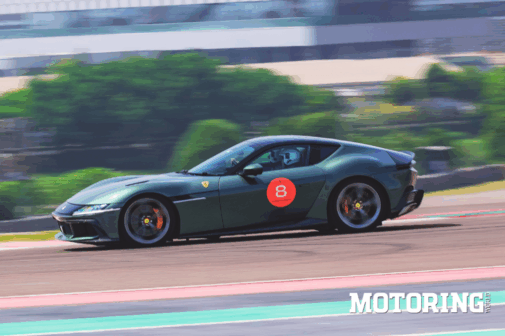
You realise that you’re not so much driving the 12Cilindri as collaborating with it, conducting a mechanical orchestra where every input is met with a perfectly timed and weighted response. This is the good kind of relationship, where both parties actually communicate. The balance here is remarkable for a car with its engine sitting so far up front. Ferrari has somehow engineered this grand tourer to feel agile and almost mid-engined in its behaviour, the rear-wheel steering and sophisticated suspension working to erase any sense of mass. It’s automotive sorcery, the kind of thing that makes you wonder what is going on in Maranello.
Hitting the short straight, you finally let the engine fully breathe. This is the moment the 12Cilindri transcends mere machinery and becomes something else entirely. The V12 comes alive past its mid-range, transforming from a powerful engine into an emotional event. It builds, it layers sound upon sound, and finally explodes towards its 9,500 rpm crescendo with a fury that is both terrifying and beautiful.
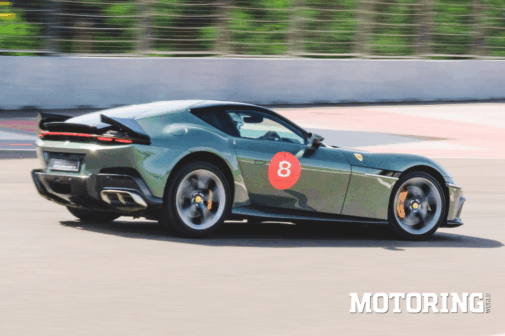
This is where the naturally aspirated engine still reigns supreme over any turbocharged or hybrid rival, and frankly, it’s not even close. No lag, no hesitation, no artificial plateau of torque. Just pure, climbing, intoxicating power that feels infinite, like the engine will keep pulling forever if you just keep your foot down and ignore both physics and self-preservation instincts.
Through the more technical mid sector corners, the car’s surprising nimbleness shines. The steering is so incredibly quick that it demands small, precise inputs. There’s no slack in the system, no dead zone at centre. Every micro-movement of your hands translates instantly into a change of direction, making the car feel like an extension of your own nervous system. It’s a car that demands your complete, undivided focus (put your phone away, you won’t be checking it), but rewards precision with a level of driver engagement that few modern supercars can even approach.
Approaching the long, fast right hander that defines the circuit’s character, you must fully commit. No half measures, no tentative approaches. You carry immense speed, trusting the active aero and the chassis to keep you glued to the line. The car stays planted, composed, defying its physical dimensions and the basic laws of physics. The active aerodynamic elements work silently in the background, generating downforce and managing airflow without ever making a show of it. No dramatic spoilers rising and falling like a peacock’s display, just quiet, efficient engineering doing its job.
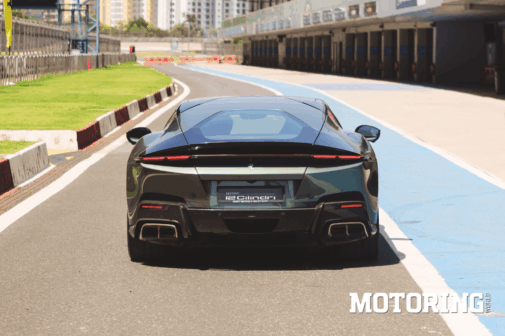
Then, the final straight. One last, glorious push. Your right foot mashes the throttle to the stop, and the engine responds with a magnificent scream. This is the 12Cilindri’s natural habitat: high speeds, high revs, and that endless, seemingly inexhaustible straight-line pull that makes you question whether 9,500 rpm is actually the limit or just a suggestion. Crossing the finish line, your heart is pounding, your ears are ringing with the ghost of that V12 wail, and you realise that you’ve just experienced something incredibly rare in the modern automotive world.
There are fast cars. There are Ferraris. And then there’s the 12Cilindri, which exists in its own rarefied atmosphere somewhere between ‘automotive masterpiece’ and ‘religious experience.’ It arrives at a peculiar moment in history, when the internal combustion engine feels like a beautiful relic, something we’ll tell our grandchildren about while they silently judge us for destroying the planet. Yet here, on the tarmac of the Buddh International Circuit, such existential hand-wringing evaporates faster than petrol on a hot exhaust manifold. The moment you lay eyes on the 12Cilindri, you understand immediately that this isn’t just another modern supercar obsessed with Nürburgring lap times or absurd downforce figures. This is Ferrari going back to its roots, not as some cynical nostalgia exercise, but as a defiant, glorious middle finger to anyone who thinks naturally aspirated V12s are dead.
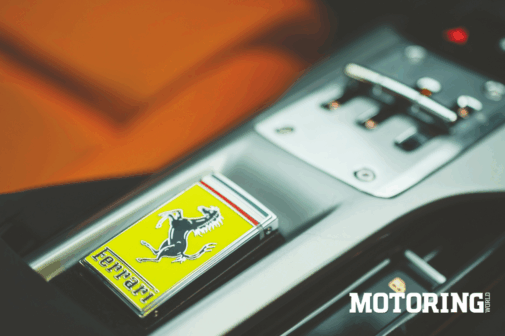
Before the engine springs to life, Ferrari provides a subtle hint of the theatre to come. The key fob is shaped like the Prancing Horse logo, a sculptural piece that feels cool and weighty in your palm, like a very expensive piece of jewellery that also happens to start an 818 bhp supercar. You press the starter, and the world outside the cockpit ceases to exist. The 6.5-litre naturally aspirated V12 fires with a violent crack that immediately settles into a rich, mechanical, slightly menacing idle. There’s no hybrid silence here, no artificial sound being piped through speakers (I’m looking at you, various German performance cars). This is unadulterated combustion, a symphony of pistons and valves and pure, unburnt passion that makes environmentalists weep and petrolheads grin like idiots.
This engine produces 818 bhp and revs with ferocious urgency to a 9,500 rpm redline, which is the kind of number that makes you check if you read it correctly. It’s the absolute heart of the 12Cilindri, and Ferrari has built the entire driving experience around its singular character. Even before you release the brake, blipping the throttle sends a shiver through the carbon fibre chassis, and you know that you’re about to experience something extraordinary.
Walking around the 12Cilindri is an education in design restraint and heritage (two concepts Ferrari occasionally forgets about, but not this time). At first glance, the car looks aggressively futuristic, like a concept vehicle that escaped from Maranello’s design studio before anyone could approve it for production. The front fascia is dominated by a clean, sharp horizontal element and a dark, visor-like band that stretches across the nose. It’s vaguely menacing. But spend a moment longer — and honestly, you’ll spend many moments staring at this thing — and the echoes of the past begin to reveal themselves. This is a clear, loving nod to the legendary Ferrari Daytona, a car whose simple, powerful lines defined an era.
The long, muscular bonnet stretches endlessly ahead, housing that magnificent V12 in what can only be described as a glass encased shrine (because if you’ve built a naturally aspirated V12 in 2024, you might as well show it off). The cabin sits pushed rearwards, maintaining the classic front-engine GT proportions that Ferrari perfected decades ago, and that modern mid engine supercars have abandoned in pursuit of optimal weight distribution. The rear is a sculptural masterpiece of active aerodynamic elements that subtly shift and adjust at speed, deploying and retracting with quiet, purposeful efficiency. It’s a design that grows on you, a slow release dopamine hit that rewards a second, third, and fourth look. Standing next to it on the pit lane, I honestly had to pinch myself. Was I actually here? Was this real? Or had I fallen asleep watching old Top Gear episodes and was now living in some sort of automotive fever dream?
This is not a car for the faint of heart, nor is it a machine that apologises for its extravagance. It doesn’t care about your carbon footprint, your fuel economy concerns, or your sensible opinions about electrification. It is a testament to the internal combustion engine in its most glorious V12 form, and we can happily report that rumours of ICE’s death have been greatly exaggerated. On the track, it delivers an experience that is raw, refined, and utterly unforgettable. Having experienced this car on the sweeping tarmac of the BIC, I understand that it demands respect, rewards courage, and leaves you breathless (and possibly slightly deaf).
Sebastian Vettel, the four-time world champion who once drove Ferrari’s scarlet F1 cars with the kind of skill that makes the rest of us look like we’re driving shopping trolleys, famously said: ‘At the end of the day, everyone is a Ferrari fan.’ After a day behind the wheel of the 12Cilindri, I can only add one thing: for very good reason.
Now, if you’ll excuse me, I need to go figure out how to finance one of these.