

The Tata Sierra has always occupied a curious place in Indian automotive history. It wasn’t the country’s first SUV, nor was it its best seller, but it became one of those rare cars people continued talking about long after it disappeared from showrooms. That distinctive wraparound rear glass, the upright stance, and the promise of adventure turned it into an icon, even if relatively few people actually owned one. Bringing back a name like that is never easy. Lean too heavily on nostalgia, and you end up building a museum piece; ignore the past completely, and you might as well have called it something else.
Tata appears to have understood that balancing act from the beginning. Rather than trying to recreate the original Sierra, it has used the old car as inspiration for something thoroughly modern. This isn’t a retro revival in the mould of a Mini or a Defender. It’s an electric SUV that happens to carry one of the most recognisable badges in Indian motoring, and after spending a day driving it around Coimbatore, it became increasingly clear that the badge isn’t carrying the car. If anything, the car is doing the badge proud.
Interestingly, Tata chose not to launch it in the sort of scenic location you’d normally associate with an SUV. We found ourselves at the CoASTT High Performance Centre on the outskirts of Coimbatore, a facility better known for driver training and motorsport than family SUVs. At first, the venue felt slightly unexpected; then, the day’s programme began to unfold, and it all started making sense.
The first exercise was conducted on the circuit’s main straight, where Tata wanted us to experience the Sierra’s acceleration before anything else. Press the dedicated Boost button, bury the accelerator, and the SUV lunges forward with an urgency that catches you slightly off guard. Like every powerful electric vehicle, the Sierra delivers its performance without any of the usual mechanical theatre. There’s no waiting for revs to climb or gears to kick down — it simply goes.
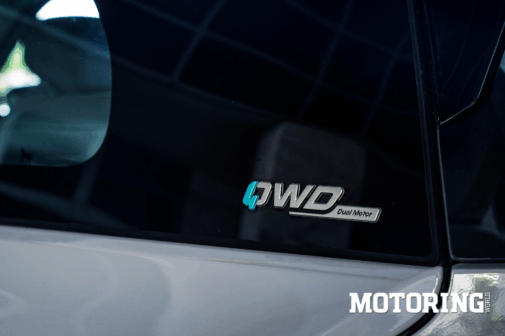
The dual-motor Quad Wheel Drive version produces 313 bhp and 51.39 kgm of torque, enough for Tata to claim a 0-100 kph time of around 5.3 seconds. They’re impressive numbers, certainly, but what stays with you isn’t the stopwatch; it’s the immediacy. The first few metres happen so quickly that your brain is still processing the launch, while the speedometer is already climbing into territory you’d normally associate with considerably more expensive machinery.
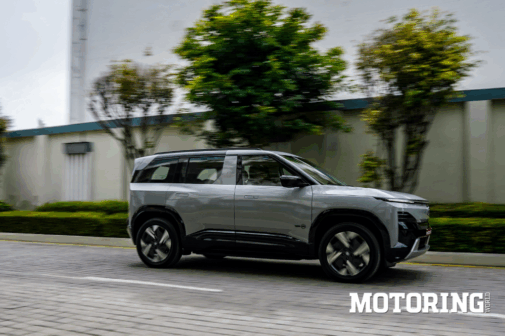
That initial burst of performance, however, is only part of the story. What impressed me more was how approachable it all felt. Plenty of fast EVs deliver a dramatic shove that almost overwhelms the driver, but the Sierra doesn’t. The power is substantial, but it’s also easy to meter out, making the car feel quick rather than intimidating.
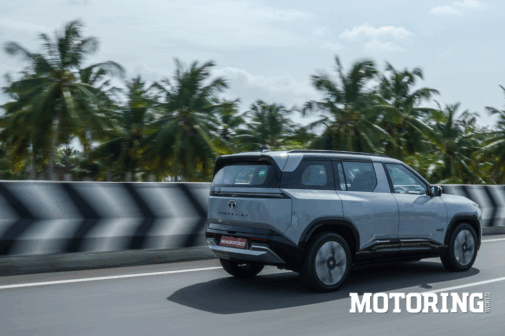
The circuit’s layout gave us the chance to explore more than just straight-line speed. Through CoASTT’s flowing corners and quick direction changes, the Sierra remained quite composed, for something carrying a large battery beneath the floor. Body movements were well controlled, and the chassis never felt flustered, even when the pace increased. The Quad Wheel Drive system went about distributing power without making its presence obvious, and that’s perhaps the greatest compliment you can pay it. Instead of constantly reminding you how clever the electronics are, it simply allowed the Sierra to put its performance down cleanly and get on with the job.
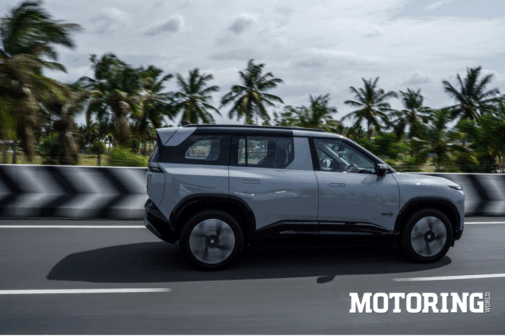
The brakes were equally reassuring. Repeated heavy stops from triple-digit speeds failed to unsettle the car, and the pedal retained a consistent feel throughout. It never felt like a performance SUV pretending to be a family car, nor did it feel like a family SUV trying too hard to be sporty. Instead, it struck a sensible middle ground that suited its character rather well.
After a morning on the circuit, Tata pointed us away from the tarmac and towards a purpose-built off-road course. That’s where the Quad Wheel Drive system had its chance to justify its name, and where the Sierra began showing a very different side of its personality.
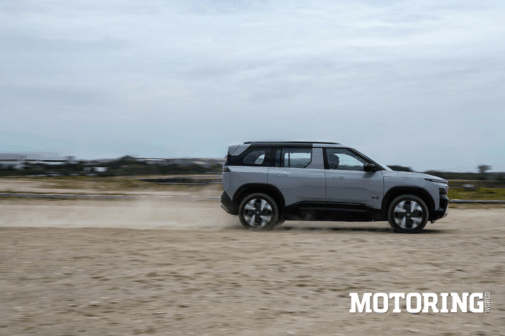
The course included steep climbs, descents, articulation ramps, and loose gravel, and what stood out was how little fuss the Sierra made of them. Electric motors have an inherent advantage off-road because maximum torque is available from the moment they begin turning, allowing more precise control than many conventional drivetrains. The Sierra makes excellent use of that characteristic, crawling over obstacles with a calmness that inspires confidence, even if you’re not particularly experienced off-road.
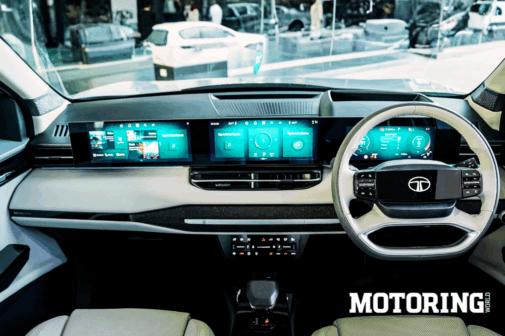
One feature I hadn’t expected to appreciate as much as I did was the off-road cruise control system. Select a low speed, remove your feet from the pedals, and the Sierra manages the throttle and braking while you concentrate solely on steering. It sounds like the sort of feature you’d dismiss as a gimmick until you try it on a steep, slippery descent, where suddenly it makes sense.
The articulation ramps provided another useful demonstration of how the drivetrain works. Even with a wheel hanging clear of the ground, the Sierra wasted very little time figuring out where the available grip was, redirecting torque to the wheels still in contact with the surface and carrying on without any unnecessary drama. It all happened quietly in the background, leaving you to concentrate on placing the car rather than wondering whether you’d become stuck halfway through an obstacle.
Then came the mud pit.
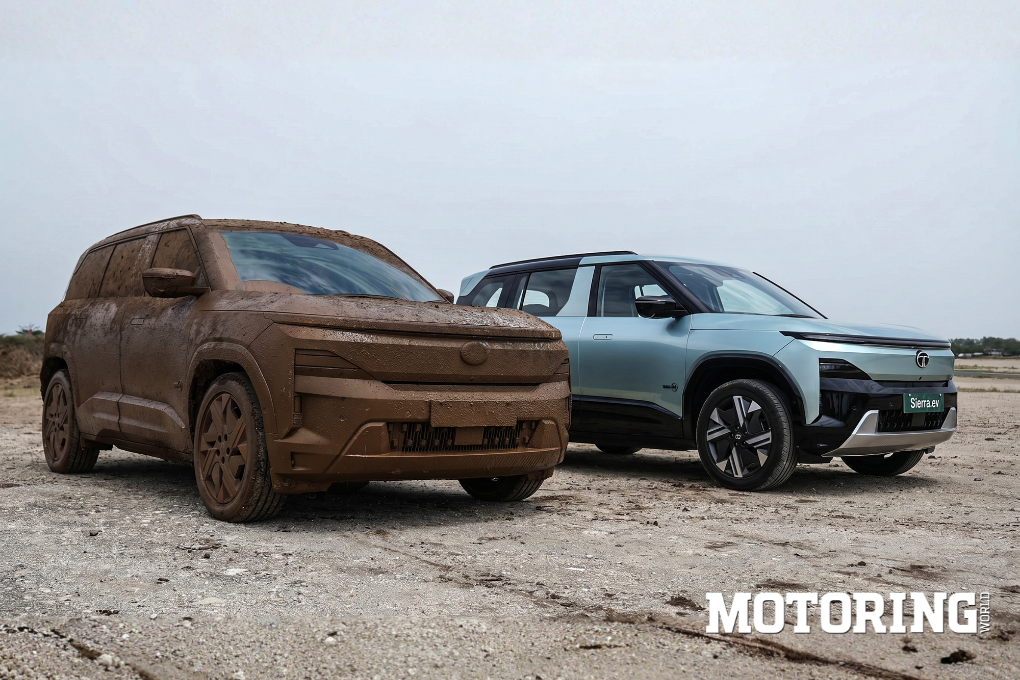
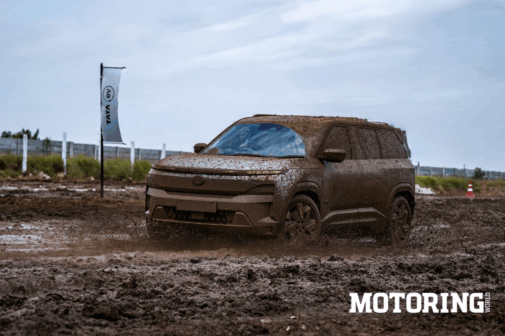
By this point, every Sierra had already accumulated a respectable coating of dust, but Tata clearly wasn’t interested in respectable. The final section of the course was little more than a large pool of thick, slippery slush designed to test both the tyres and the four-wheel-drive system. Within moments, our previously spotless test car was wearing mud from the roofline down to the wheel arches, yet the Sierra simply dug in and kept moving. The traction never seemed to disappear completely, and even when the surface became particularly slippery, the drivetrain found grip and carried on.
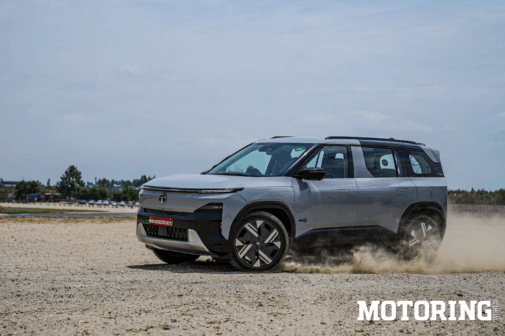
Tata even included a Drift Mode, a feature that initially sounds completely at odds with the Sierra’s family-friendly brief. Unsurprisingly, it isn’t something owners are likely to use every day, but on a loose gravel surface, it allowed the rear of the car to rotate progressively without becoming intimidating. More than anything, it demonstrated that the engineers weren’t solely focussed on efficiency figures and range estimates. Somewhere along the line, they remembered cars are supposed to be enjoyable too.
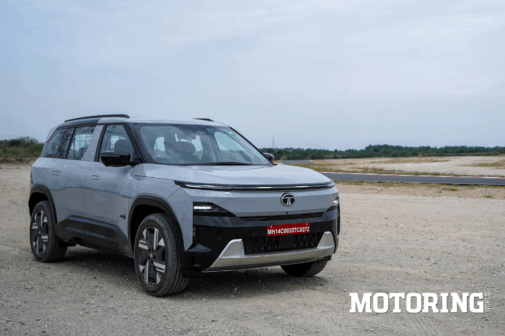
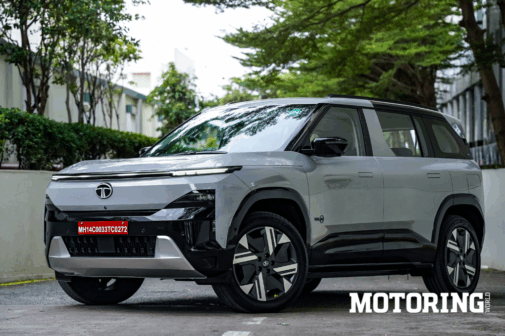
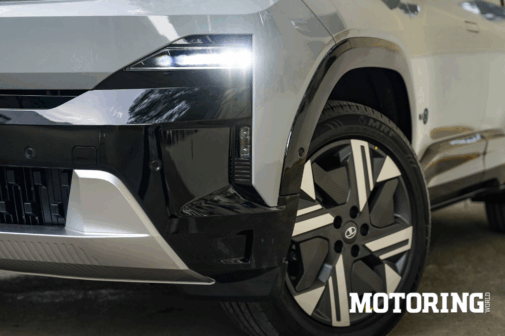
Only after spending the morning exploring the Sierra’s limits did we finally point it towards the public road, where it will spend almost all of its life. Visually, Tata has resisted the temptation to turn the Sierra into a retro exercise. The silhouette clearly references the original, particularly around the glasshouse and upright stance, but everything else feels contemporary. The blanked-off front panel immediately identifies it as an EV, while the full-width lighting, flush door handles and clean surfacing give it a modern appearance without trying too hard.
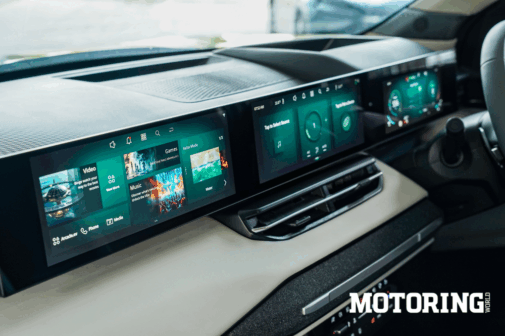
The cabin follows a similar philosophy. It’s clean, spacious, and thoughtfully laid out, with three screens dominating the dashboard without making it feel cluttered. Rear-seat space is particularly impressive, helped by large windows that make the cabin feel bright and airy, while the panoramic sunroof only reinforces that sense of openness. The boot is deep enough for a family holiday, and the equipment list is extensive without becoming the main talking point. Wireless smartphone connectivity, a head-up display, a 540-degree camera, Level 2 ADAS, rear entertainment, an air purifier, and a JBL audio system with Dolby Atmos are all present. Charging, too, has reached the point where it feels less like a compromise than it once did. Tata claims the Sierra can add up to 250 km of range in 15 minutes using a DC fast charger. During our drive, a brief stop lasting little more than the time it took to grab a coffee added roughly 180 km. Increasingly, charging is simply something the car does while you’re doing something else.
By the end of the day, it became clear that the Sierra.ev isn’t relying on nostalgia to win buyers over. Yes, the badge carries plenty of emotional weight, but the car underneath feels capable enough to stand on its own merits. It’s quick without feeling intimidating, composed on the road, unexpectedly capable away from it, and practical enough to work as a family SUV every day. The original Sierra earned its reputation by being unlike anything else on Indian roads at the time. Three decades later, the new one arrives in a very different market, but with much the same ambition. Judging by what we’ve experienced, Tata has every reason to feel confident that history might just repeat itself.