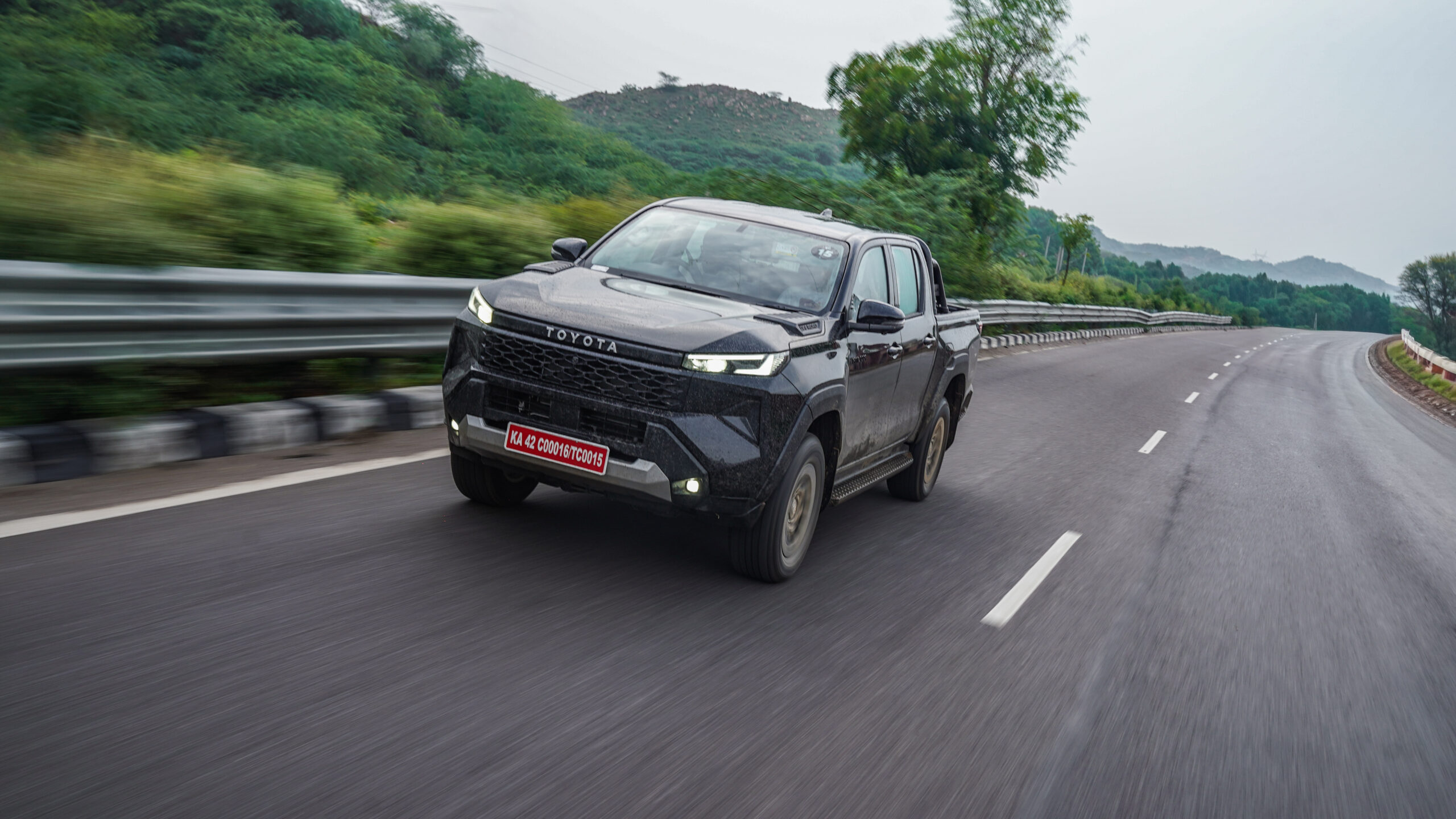


Jaipur doesn’t usually look like this. When Toyota invited us to Rajasthan for the first drive of the new Hilux, I had pictured blazing sunshine and shimmering desert highways disappearing into the horizon. Instead, the city welcomed us with grey skies and relentless monsoon rain. Roads glistened under standing water, and every puddle looked deep enough to hide a surprise. As it turned out, Toyota couldn’t have ordered better weather.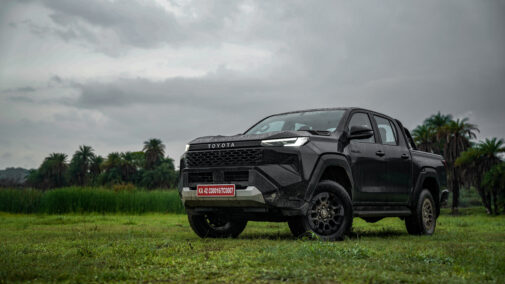
If there’s one vehicle that has built its reputation on thriving in deteriorating conditions, it’s the Hilux. Across continents, it has become the default answer to one simple question: if you had to drive somewhere with no guarantee of a road, what would you take? Its reputation stretches well beyond the automotive world.
Farmers, explorers, aid organisations and television presenters have all relied on it, and over the decades it has acquired an almost mythical status for simply refusing to stop. That kind of legacy creates its own challenge. When your product is already regarded as one of the toughest vehicles on sale, every new generation has to improve without losing the qualities that made it famous.
View this post on Instagram
Before we even climbed aboard, Toyota announced prices. Given how aggressively new vehicles have crept up the price ladder over the past few years, I expected the Hilux to follow suit. Instead, the pricing felt surprisingly restrained. Slotting in between ₹31.99 lakh and ₹36.7 lakh (ex-showroom), it undercuts several premium SUVs while continuing to offer something none of them can: genuine pick-up capability. Toyota has also broadened the range with multiple variants and attractive finance schemes, clearly recognising that the Indian market is slowly warming to lifestyle pick-ups.
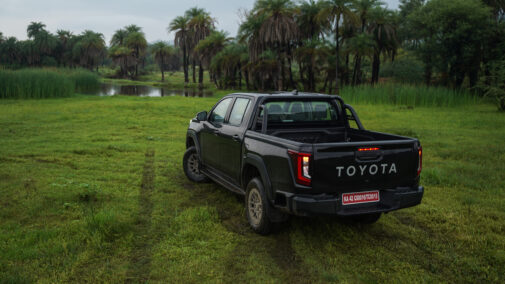
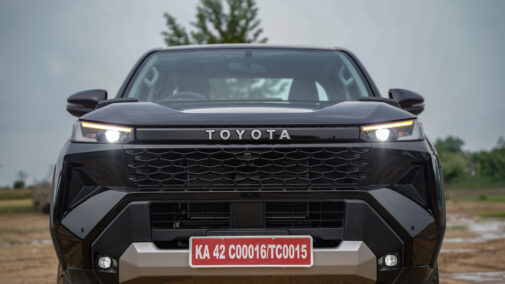
Parked outside the hotel, the new Hilux looked familiar enough that you wouldn’t mistake it for anything else, yet different enough to notice the changes immediately. The front end is where Toyota has concentrated most of its efforts, replacing the softer face of the outgoing model with a much squarer, more upright design. Toyota calls it the ‘Cyber Sumo’ look, although the name matters far less than the result. The grille is broader, the bonnet sits higher, and the slimmer LED headlamps give the truck a more contemporary appearance without trying too hard. It still looks unmistakably like a Hilux.
View this post on Instagram
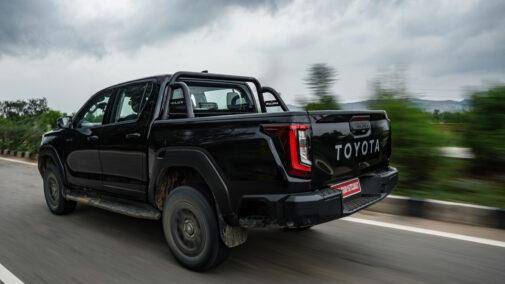
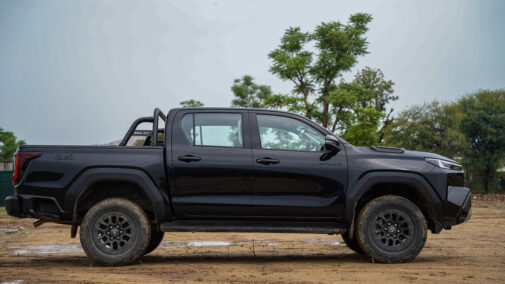
Elsewhere, Toyota has wisely resisted the temptation to reinvent the pickup. The familiar proportions remain, with pronounced wheel arches, chunky alloys and a generously sized load bed reminding you that this is still, first and foremost, a working vehicle. Around the back, the stamped tailgate proudly carries the Toyota name rather than an oversized badge, a detail that’s become something of a Hilux trademark over the years.
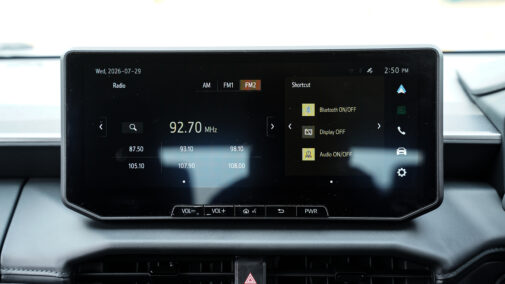
Step inside and the improvements become more noticeable. Previous Hilux cabins were never criticised for durability, but they did feel utilitarian beside similarly priced SUVs. This one narrows that gap considerably. The dashboard has been redesigned around a new 10-inch touchscreen that finally feels modern, complete with wireless Apple CarPlay and Android Auto. Ahead of the driver sits a crisp digital instrument display, while a wireless charging pad acknowledges the reality that most of us now arrive with a smartphone before we remember our wallet.
Material quality has taken a welcome step forward too. There are softer surfaces in the places you touch most often, better textures across the dashboard and a generally more polished feel than before. Yet Toyota has avoided the temptation to bury everything inside a touchscreen.
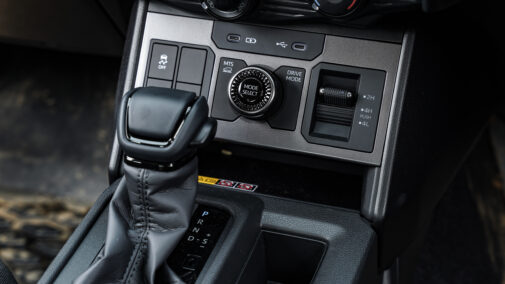
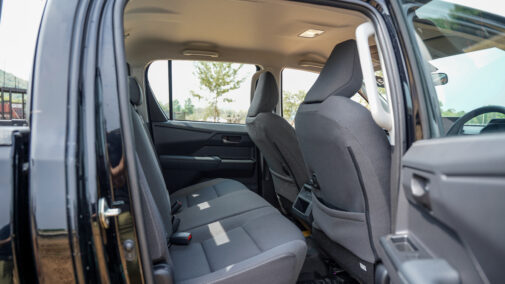
Climate controls remain physical, as do the major switchgear functions, making the cabin refreshingly easy to use while bouncing across rough tracks or wearing gloves. It feels like an interior designed by people who actually expect the Hilux to venture beyond shopping malls. Not everything available overseas has made it to India. Ventilated seats and dual-zone climate control are still absent, which feels like a missed opportunity at this price point. Even so, the cabin is a considerable improvement over its predecessor and strikes a sensible balance between comfort and durability.
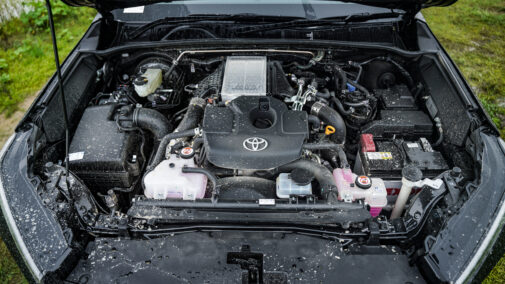
The mechanical package, meanwhile, remains reassuringly familiar. Beneath the bonnet sits Toyota’s proven 2.8-litre four-cylinder turbo-diesel, producing 201 bhp and 500 Nm of torque. Some manufacturers have begun moving away from diesel altogether, but in a vehicle like this it still makes perfect sense. The Hilux lives on torque, and this engine delivers it in abundance. Whether pulling away from a junction, overtaking slower traffic or climbing steep gradients, there’s always a healthy reserve waiting beneath your right foot.
View this post on Instagram
Toyota has also spent time refining the engine rather than replacing it. It’s quieter than before, vibrations are better suppressed and refinement has taken a noticeable step forward without sacrificing the muscular character that suits the Hilux so well. Paired with the six-speed automatic gearbox, the powertrain feels relaxed and unhurried, preferring to let its broad torque curve do the heavy lifting rather than chase high revs. That’s exactly how a vehicle like this should behave, and as we left Jaipur behind in search of wetter, muddier roads, it already felt perfectly suited to the job ahead.
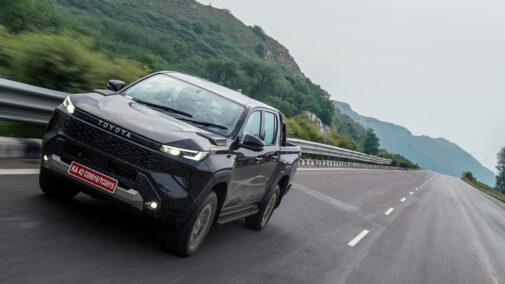
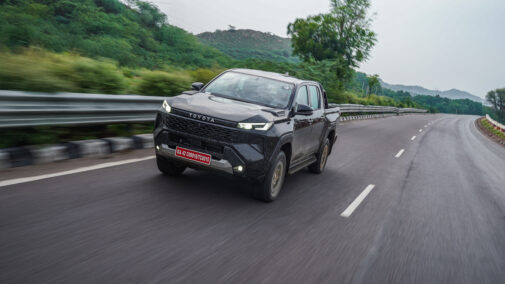
The first few kilometres were enough to reveal where Toyota had spent its engineering budget. Previous Hiluxes always felt immensely capable, but they also reminded you they were, at heart, pick-ups. The rear suspension could become busy over broken roads, particularly when the load bed was empty, and sharp bumps occasionally sent an unmistakable shudder through the cabin. This one feels calmer. Toyota has re-tuned the suspension, and while the underlying ladder-frame architecture remains unchanged, the way it deals with rough surfaces is noticeably more polished. Broken tarmac, expansion joints and potholes are dispatched with far less fuss than before, while high-speed stability has improved too. The Hilux still isn’t trying to mimic a monocoque SUV, nor should it. Instead, it feels like a well-sorted pick-up that’s become more comfortable without losing its rugged character.
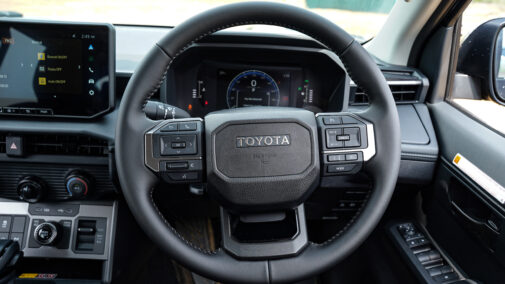
The steering follows a similar philosophy. It’s light enough to make manoeuvring something this substantial surprisingly straightforward, yet it retains enough weight at higher speeds to inspire confidence. The elevated driving position gives you an excellent view of the road ahead, while the new 360-degree camera proves invaluable when squeezing through narrow streets or placing the Hilux precisely off-road.
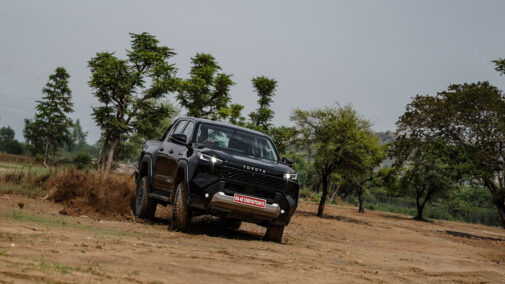
The off-road section arrived sooner than expected. The overnight rain had transformed Toyota’s test course into exactly the sort of terrain buyers dream about when they first imagine owning a Hilux. Deep ruts, slippery climbs, axle-twisting articulation sections and generous quantities of mud gave the truck every opportunity to justify its reputation.
Engage four-wheel drive, select low range where necessary and the Hilux simply gets on with the job. Ground clearance, generous approach and departure angles and the locking rear differential allow it to crawl through obstacles with remarkable composure, while the electronics intervene so unobtrusively that they rarely draw attention to themselves. Rather than feeling dramatic, the experience is almost reassuringly uneventful.
View this post on Instagram
You point the Hilux where you want it to go, feed in the throttle and let the hardware do what it has been engineered to do. That’s perhaps the greatest compliment you can pay any serious off-roader. It inspires confidence without demanding heroics from the driver.
Back on the road, the improvements continue to make themselves felt. Wind and road noise have been reduced, refinement is noticeably better than before, and long-distance cruising feels less tiring than the outgoing model. This is still a large diesel pick-up, so you remain aware of its size in tighter urban environments, but once the roads begin to open up, it settles into an easy, unhurried rhythm that suits its character perfectly.
The Hilux has never been a vehicle bought purely with the head. There are more practical SUVs, more luxurious ones and certainly quicker ones for similar money. People choose a Hilux because it represents something different. It’s as much about where it could take you as where you’ll actually drive it. Toyota has recognised that it didn’t need to reinvent that formula. Instead, it has focussed on the areas owners interact with every day. The cabin is more modern, the ride is more composed, refinement has improved, and the technology finally feels in keeping with the price tag. Crucially, none of those changes have diluted the qualities that made the Hilux such a respected name in the first place.
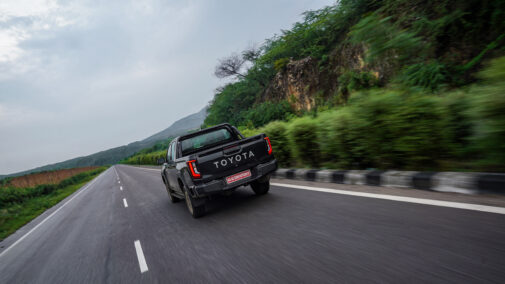
Driving through a rain-soaked Rajasthan wasn’t what any of us had expected when we boarded the flight to Jaipur. In hindsight, though, the weather became the perfect backdrop for this update. The muddy tracks, broken roads and standing water highlighted exactly why the Hilux has earned its reputation over decades, while the quieter cabin, improved ride and more polished manners demonstrated just how much progress Toyota has made. The new Hilux tells its story with a little more refinement than before, and that’s exactly the update it needed.